Showing posts with label turkey. Show all posts

Wednesday, November 21, 2012

Make Your Thanksgiving a Healthy One: 5 Tips to Keep from Overindulging


The holidays are often a time filled with overconsumption.  The temptations of succulent turkey, tasty tarts and pies and savory side dishes can often times be lure that you just can’t resist.  But if you’re looking to eat healthy on Thanksgiving, it doesn’t mean you have to give up all your favorite foods, says Jennifer K. Nelson, a registered dietician and director of clinical dietetics at the Mayo Clinic in Rochester, MN. 

"If you've got your eating under control for the majority of the time, go ahead and have a piece of pie — just don't lose control entirely," Nelson told MyHealthNewsDaily. "Keep your willpower and your wits about you."

Here are 5 tips and tricks to help you eat avoid overindulgence this holiday.

1.       Stick to healthy portions.

Only one plate of food is all you get, says Nelson.  She advises to fill up half the plate with fruit, vegetables, and a whole wheat roll.  A quarter can be filled with either mashed or sweet potatoes and the other quarter with turkey or ham.  She also advises that the more colorful the arrangement on your plate, the better.  This means adding leafy greens, carrots, bell peppers, beets, cranberries and other vegetables as much as you can.

"If you fill up on those lower caloric density and higher nutrition things, you're going to feel full, but not bloated and tired, because it's a lighter fare," she said.

It is a holiday so if your diet allows, indulge a little bit.  Caution: if you’re going to eat desert, make sure you allow for the calories by decreasing them somewhere else. Don’t go back for a second helping of potatoes if you want to have a little dessert. Dee Sandquist, spokeswoman for the American Dietetic Association, advises to choose the cranberry salad if you are still hungry.

Sandquist also advises that if you are choosing pie, go for a fruit or pumpkin pie because they tend to have fewer calories rather than the chocolate or pecan pies.  She also says to try and stick to a single serving of your more unhealthy choices.  Aim for a half-cup of mashed potatoes and a 3 ounce serving of turkey.

2.       Eat before you indulge.
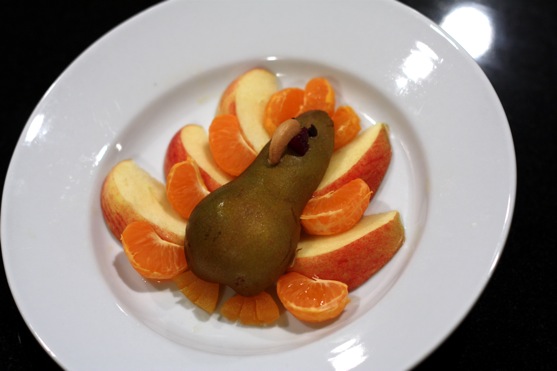

Don’t try and starve yourself throughout the early part of the Thanksgiving Day.  This is a recipe for overeating.  If you are going to a Thanksgiving lunch, make sure to eat breakfast before you go.  If you are going to a dinner, be sure to eat lunch or have a small snack.

"You definitely want to have your normal meals because otherwise, whenever we get over-hungry, we overeat," she said.

3.       Try to substitute healthy ingredients for the more unhealthy ones.

There are endless ways to make your Thanksgiving food healthier.  For your mashed potatoes, Nelson advises that mixing in chicken broth or herbs and garlic can add flavor without adding calories.  For your green bean casserole, substitute the friend onions for toasted almonds, adding protein and decreasing fat.  Sandquist also suggests that instead of a sugary cranberry sauce; instead opt to serve a cranberry salad.  For dips, substitute Greek yogurt for the sour cream; the consistency will be similar but less fat and more protein.  

Another easy way to cut fat and calories is to skip eating the skin on your turkey.  The dark meat has slightly more fat than the white meat, but limiting your unhealthy side choices will be more beneficial in the long run than choosing one meat over the other.

If you are making your pies from scratch, choose a whole wheat pie crust and substitute low-fat or skim milk instead of the evaporated milk. 

4.       Drink lots of water and go for a walk after your meal.


Sanquist says that many times people will mistake thirst for hunger.  By drinking water throughout the day you will decrease your odds of overeating.  It is also a good idea to take a walk after the big meal to help increase metabolism.

 
5.       Avoid snacking.

Sandquist says to abide by the “out of sight, out of mind” mantra.  She advises once you fill your plate with food, cover it up and put it away.

"It'll help you avoid mindless munching," she said.  When you snack throughout the day, you can lose track of how much you have eaten.
adapted from: http://www.myhealthnewsdaily.com/569-five-tips-avoiding-overindulging-thanksgiving.html

Monday, November 19, 2012

Let’s Talk Turkey: Tips to Eat Your Bird Safely This Thanksgiving


Thanksgiving is often times celebrated by overindulging in a delicious turkey dinner spread and counting blessings for the past year.  Before your bird hits the table there are a number of steps that need to be taken to ensure a succulent turkey and one free of disease causing organisms.

Ben Chapman, a food safety specialist and assistant professor of food science at North Carolina, said that fixings for the big meal are complicated.  But you if follow some simple advice, you can help yourself to ensure that your meal goes off without a hitch.

1.       Thaw your turkey.

·         If you are going to be frying your turkey, make sure that you thaw the bird.  Putting a frozen bird into a hot fryer can lead to a big mess, and a lot of danger, an event that can be due to the turkey’s temperature and the water content. "It has to do with the temperature change. You're putting something really cold into something really hot and that affects what the oil is going to do," Chapman said, adding that this "exploding turkey" phenomenon is outside his expertise.

·         "I had guessed that the water in the turkey, or whatever, boils very fast causing the surface to explode with bubbles, some of which could spray oil on the burner," John Coupland, associate professor of food science at Penn State, said in an e-mail to LiveScience. "So wet rather than cold is the key variable."

·         Thinking about where you might be able to defrost your bird for the big day?  Chapman recommends placing the turkey in the refrigerator, microwave, or under cool water.  Caution: all methods come with their own risks.  When using the fridge, you need to make sure that the turkey thaws all the way through, which means making sure the center doesn’t remain frozen. 

·         The United States Department of Agriculture guidelines for thawing your turkey in the fridge:

o   4 to 12 pounds: 1-3 days

o   12 to 16 pounds: 3-4 days

o   16 to 20 pounds: 4-5 days

o   20 to 24 pounds: 5-6 days

2.       Don’t wash the turkey!

·         "As soon as you have the pressure of the water hitting the turkey it can spray anything on the outside of that turkey around the kitchen," Chapman told LiveScience.

·         Researchers in the UK recently discovered that forceful water hitting the turkey has the potential to spray pathogens up to three feet.

·         Instead, Chapman recommends wiping the outside of the turkey with a damp rag and immediately throwing out the rag or putting it in the washing machine.  "Treat that damp rag like a raw chicken," he said, adding that it likely contains the pathogens you're trying to avoid.

3.       Cook your bird!

·         "The most important thing is cooking that turkey to 165 degrees Fahrenheit (74 degrees Celsius), and there's only one way to know whether you've cooked it safely and that is to use a thermometer." Campylobacter and Salmonella can’t grow until the temperature reaches 45 degrees Fahrenheit and are killed when the temperature reaches 165 degrees Fahrenheit.

·         Some think that the color of the juice can be an indicator that the meat is done, but this is not the case.  The juice color from the meat does change as the bird cooks but that does not mean that the bird is safe to eat.

·         To check if you turkey is done: place a tip-sensitive digital thermometer into 8-10 spots on the turkey.  When the thermometer reads at least 165 degrees all around, then it is time to come out. Chapman advises to target thick areas on the turkey, away from the cavity or bone because bone conducts heat better and can give a false reading.

4.       Hurry; put the turkey in the fridge!

·         As soon as you are done with the meal, Chapman advises putting the turkey in the fridge.  If any pathogens are left on the turkey they can begin to grow at 135 degrees Fahrenheit.  Even if you thoroughly cooked the bird in the oven, new pathogens could have taken up residence.  For example, Staphylococcus aureus lives on most of us around our eyes and noses. However, it doesn't release its toxins until it has a food source, such as the warm turkey meat. Rubbing your nose or an eye while handling the turkey could give the staph a free ride onto the food. The cold temperatures in your fridge will slow down growth, keeping the pathogen at safe levels.

·         Chapman also suggests dividing your meat into smaller portions to increase the surface area exposed to the cold temperatures and slow down pathogen growth.

5.       Have left overs? Repeat the above steps.

·         Chapman says that repeating the same steps for a raw turkey as a cooked turkey are important to keep your food safe.  Pull out the thermometer again to check the temperature of the meat.  Even if you warm your bird up in the microwave, still check that the temperature is at 165 degrees Fahrenheit to reduce the chance for disease.

Adapted from: http://www.livescience.com/10272-talking-turkey-tips-eat-bird-safely.html